
- Q1 net sales and revenues: $9.61B (+13% YoY)
- Equipment net sales: $8.00B (+18% YoY)
- Q1 net income: $656M; EPS: $2.42
- Equipment operating margin: 5.9% (ahead of plan)
- Small Ag & Turf net sales: $2.17B (+24% YoY), margin 9% (FY margin guide raised to 13.5–15%)
- Construction & Forestry net sales: $2.67B (+34% YoY), margin 5.1% (FY margin guide raised to 9–11%)
- PPA (large ag) net sales: $3.16B (+3% YoY), with FY margin guide reaffirmed at 11–13%
- FY26 net income outlook raised to $4.5–5.0B
- Equipment operations FY26 cash flow guide raised to $4.5–5.5B
- Financial Services Q1 net income: $244M; FY26 outlook raised to $840M
- Global large ag industry in U.S./Canada still expected down 15–20% in FY26
- South American ag equipment industry now expected down ~5%
- Tariff burden unchanged at ~$1.2B in FY26
A diversified machine room keeps humming
John Deere opened its fiscal year with the air of a company that has learned to live with a split personality. On one side sits a subdued row-crop farmer, still squeezed by margins and wary of big-ticket purchases. On the other, a confident construction contractor, buoyed by infrastructure bills, data centres and the slow thaw of interest rates.
The numbers from the first quarter show those worlds colliding quite profitably. Net sales and revenues rose 13% year-on-year to $9.6bn, with equipment operations up a robust 18% to $8.0bn. Net income came in at $656m, or $2.42 per share, and the equipment business delivered a 5.9% operating margin — thin by Deere’s recent standards, but comfortably ahead of management’s own plan.
Crucially for investors, all three operating segments grew the top line. Small Ag & Turf and Construction & Forestry (C&F) both posted more than 20% net sales growth, offsetting a still-muted large ag backdrop. That breadth of demand has given Deere enough confidence to declare that fiscal 2026 will mark the trough of the current agricultural cycle and to lift its full‑year net income outlook to a range of $4.5bn to $5.0bn.
The quarter’s beat was driven less by pricing and more by sheer throughput. Shipments ran ahead of plan across the portfolio, and higher volumes improved factory efficiency and overhead absorption. Management emphasised that, excluding tariffs, production costs were down year-on-year across all segments, a sign that the manufacturing engine still has room to provide operating leverage once volumes recover in large ag.
Large ag finds a fragile floor
The Production & Precision Ag (PPA) division, Deere’s flagship for big tractors and combines, is still living with the hangover of an intense boom. First-quarter net sales in the segment crept up 3% to $3.16bn, helped by nearly four points of currency tailwind. But operating profit fell to $139m, implying a meagre 4.4% margin.
The pressure points were familiar: higher tariffs, an unfavourable regional and product mix, and heavier warranty costs. North American pricing remained positive, but was neutral at the segment level as Deere applied incentives in South America to help clear inventory and respond to foreign-exchange swings. Yet Deere held its full-year PPA sales guidance — down 5–10%, with 1.5 percentage points of positive price and about three points of favourable FX — and kept the operating margin target at 11–13%.
Management’s argument is that fundamentals have stopped deteriorating and are beginning to stabilise. Deere still expects U.S. and Canadian large ag industry volumes to fall 15–20% this year, but is already seeing nuance within that range. Spring-related equipment such as planters and sprayers, ordered when uncertainty and commodity prices were at their worst last summer, will likely be toward the weaker end of the range. By contrast, large tractor orders have picked up, leaving Deere’s rolling order book in North America now stretching into the fourth quarter. Combine demand looks tolerable: the early-order programme for the year has just closed “better than expected”, with combines likely down less than the broader market.
Behind this shifting pattern lie the building blocks of a future replacement cycle. Global crop production remains high, but demand has kept pace, and grain prices have edged off last summer’s lows. In the U.S., the USDA now expects 2026 net cash farm income to rise about 3% from 2025, largely due to higher government payments rather than surging crop receipts. Beijing has resumed purchases of U.S. soybeans. Farmland values remain robust, propping up farm balance sheets even as margins are squeezed.
Most telling, Deere says, is the age of the fleet. After several years of constrained replacement, farmers are putting more hours on their machines, and the used equipment market is finally healing. North American used Deere combine inventories are roughly 15% below their March 2024 peak, with a normal distribution of model years. Used high‑horsepower tractor inventories are down more than 10% from their March 2025 peak, and late‑model units have fallen sharply: model‑year 2022 and 2023 8R tractors declined over 40% since March and more than 20% just in the latest quarter, with 2024 models also down more than 10%.
Deere has supported this clean‑up with higher “pool fund” contributions, but stresses that North American pricing remains positive. The company is still producing large ag equipment broadly in line with retail demand in 2026, a marked contrast to earlier cycles when factories continued to run ahead of the market. Outside North America, inventories are largely in hand, with one exception: combines in Brazil, where Deere will deliberately underproduce retail in the second and third quarters to drain stock, even as it highlights that its combine inventory-to-sales ratios remain well below competitors’ levels.
South America otherwise stands out as a pressure point. Deere now expects tractor and combine industry sales in the region to be down about 5%, weighed by subdued commodity prices, high interest rates and a recently stronger real, which crimps producers earning in dollars. In Europe, by contrast, Deere still sees demand flat to up 5%, with manageable financing costs and resilient arable markets.
Underpinning the longer-term ag narrative is policy. Management pointed to the U.S. Farmer Bridge Assistance programme and the potential for further support to biofuels — from higher ethanol blend mandates to expanded export opportunities — as factors that could raise structural demand for grains and, in turn, sustain equipment replacement once the current trough passes.
Small ag and turf rediscover momentum
If large tractors are limping, their smaller cousins are marching ahead. The Small Ag & Turf division delivered a brisk 24% net sales increase, to $2.17bn, powered by higher shipment volumes and modest price and currency benefits. Operating profit climbed to $196m, for a 9% margin, as better mix and price outweighed higher tariff costs.
Here, the story is as much about channel discipline as it is about demand. Last year’s deliberate underproduction in small ag left Deere with what it describes as “healthy” starting inventories. New field inventory in both tractor horsepower categories below 220HP is about 40% lower than a year ago. That lean posture has allowed the company to keep building roughly in line with retail demand, even as orders have strengthened through the first quarter.
The order book itself has brightened. In North America, midsize tractors serving dairy and livestock remain in steady demand, helped by strong beef prices. Turf equipment and compact utility tractors have seen faster order velocity as that market normalises after several years of decline. Deere still expects the U.S. and Canadian small ag and turf industry to be flat to up 5% this year, but now assumes its own segment net sales will rise about 15% in fiscal 2026, with around two points of price and a similar currency tailwind. The operating margin guidance has been raised to a range of 13.5–15%.
The net effect is that small ag and turf, once seen as the cyclical weak link in Deere’s portfolio, has become one of the more reliable contributors in this downturn, soaking up capacity, supporting margins and helping to smooth earnings volatility.
Construction & Forestry moves to centre stage
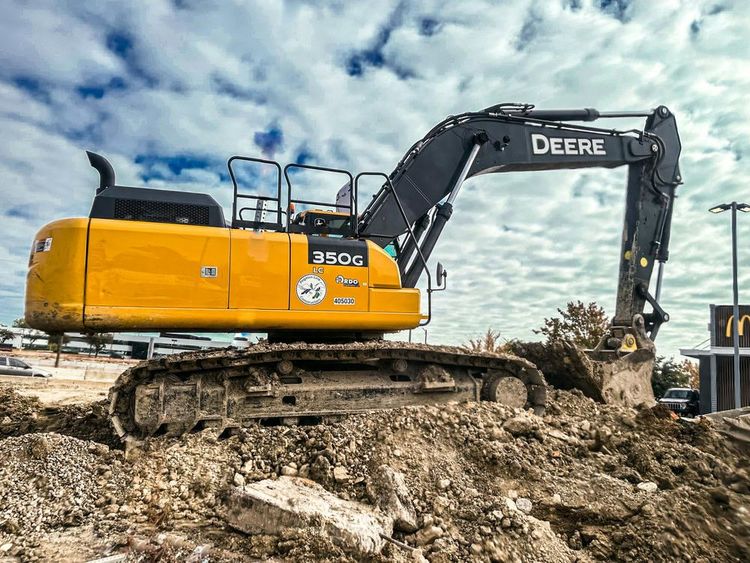
It is the Construction & Forestry segment, though, that is increasingly acting as Deere’s growth engine. Net sales jumped 34% year-on-year in the quarter to $2.67bn, supported by higher shipment volumes and a strong euro, while price realization dipped just slightly negative. Operating profit more than doubled to $137m, lifting the margin to 5.1%.
The tone from management here was distinctly more bullish than on the farm side. Deere now expects industry sales for both construction equipment and compact construction equipment in the U.S. and Canada to be up around 5% this year, compared with flat expectations previously. Roadbuilding markets globally are also forecast to grow about 5%, with particular strength in North America and Europe; forestry remains essentially flat.
Beneath those modest industry figures lies a more powerful story inside Deere’s own order books. Retail settlements in North American construction and compact equipment were up mid‑teens in the quarter, ahead of internal expectations. The C&F order bank has swollen by more than 50% over the past three months and now stands at its highest level since May 2024, giving “clear visibility into the second half” of the fiscal year. Deere’s decision to underproduce retail in C&F last year by close to 10% has set the stage for outsized revenue growth in 2026 as it simply builds in line with stronger demand.
The company now guides C&F net sales up around 15% for the year, even though the industry is only growing a third as fast. The arithmetic reflects that prior underproduction, plus roughly 2.5 percentage points of price and just over 2 points of currency tailwind. The operating margin range has been raised to 9–11%, a significant step up from the single-digit margin delivered in the first quarter as volume and mix improve.
The macro drivers are easy to trace. U.S. federal infrastructure spending is finally working its way into projects. The housing market remains soft, particularly for smaller contractors, but is expected to revive as rates ease. Data centre and AI‑related construction is beginning to show up in customer backlogs. Rental fleets are reflating after a cautious couple of years, with rental settlements up mid-teens.
Just as important is Deere’s strategic positioning in this part of the cycle. Management frames its construction strategy in three “layers”: machines, tasks and job sites. On the machine front, the company is about to take a symbolic step: at the upcoming CONEXPO show in Las Vegas, Deere will introduce its own 20‑ton class excavators — fully designed by Deere and built in Kernersville, North Carolina — into a market segment that represents roughly 40% of North American construction equipment demand.
These new excavators are pitched as “packed” with productivity-enhancing, easy‑to‑use technology, with an intense focus on quality and durability. They mark the first phase of a multi‑year programme to launch a full Deere‑branded excavator line, moving decisively beyond the long-standing partnership model that defined its previous presence in the category. Management insists it will not try to take outsized price on these machines at launch, given the still competitive pricing environment in excavators, but argues that the value proposition — and embedded technology — will give it genuine differentiation.
At the “task” level, Deere is layering technologies such as SmartGrade, SmartDetect and SmartWeigh onto individual machines, often integrated with third‑party survey providers to deliver more automated, precise work. And at the “job site” level, its ambitions are overtly digital. Yesterday’s completion of the acquisition of Tenna, a contractor fleet and asset management platform, adds a new piece to that puzzle, sitting alongside Virtual Superintendent — acquired just over a year ago — and Deere’s own Operations Center.
Together, these assets are meant to give contractors tools to automate workflows, optimise mixed fleets, manage maintenance and coordinate complex sites in near real time. Notably, Deere says both Tenna and Virtual Superintendent will remain brand‑agnostic, a tacit acknowledgment that most job sites are mixed-brand by nature — and a way to turn that reality into a service opportunity rather than a barrier.
Tariffs, finance and the balance sheet
Hovering over all of this is a stubborn tariff bill. Deere still expects to incur about $1.2bn of tariff costs this fiscal year, with roughly half tied to the IEPA tariffs at issue in a pending U.S. Supreme Court case and the rest from Section 232 steel tariffs and other regimes. So far, mitigation efforts and operational efficiencies have helped the company keep production costs, ex‑tariffs, largely in check, and management now describes 2026 as broadly “price/cost neutral”, even after absorbing about $600m of incremental tariffs versus last year.
On the finance side, Deere’s captive Financial Services arm is quietly adding resilience. First-quarter net income there rose to $244m, thanks to wider financing spreads and lower provisions for credit losses, partially offset by non‑recurring benefits in the prior year. The full‑year profit outlook for the unit has been raised to $840m, reflecting a more benign credit environment than feared.
The balance sheet, meanwhile, remains sturdy enough to support both investment and shareholder payouts. Deere lifted its projection for cash flow from equipment operations by $500m at both ends of the range, to $4.5bn–$5.5bn, and reiterated an expected effective tax rate of 25–27%. In the quarter, it returned nearly $750m to shareholders through dividends and buybacks, even as it continued to pour capital into new products, digital platforms and M&A.
Technology as the quiet constant
Beyond the hard numbers, management repeatedly circled back to a theme that does not show up immediately in quarterly margins: the steady march of technology adoption across Deere’s installed base.
In large ag, the most tangible manifestation is on combines. Deere’s new harvest automation suite — covering automatic harvest settings and predictive ground speed — saw over 60% utilisation among operators last fall. That usage has already translated into higher option take rates: this year, 99% of combines ordered through the early‑order programme included some level of harvest automation, and nearly 80% opted for the top-tier “ultimate” package, roughly four to five percentage points higher than last year.
At the fleet level, Deere says it now has about 500m “engaged” acres on its digital platform, up more than 10% year-on-year, with roughly a quarter to a third of those acres categorised as “highly engaged”. That progression, spread across geographies, underpins the company’s vision of an increasingly software‑and‑data‑rich revenue stream, even if the current cycle is still dominated by hardware.
It is a similar story in construction. The excavator launch, the Tenna acquisition, the integration of precision features such as SmartGrade and the cross‑segment presence at shows like CONEXPO and Commodity Classic are all designed to send the same signal: Deere intends to be the orchestrator of increasingly complex, sensor‑laden job sites and farms, not merely a maker of iron.
A cyclical bottom with optionality
For investors, the shape of Deere’s cycle is coming into clearer focus. Fiscal 2026 is framed as the bottom for large ag, but it is a bottom cushioned by a much more balanced portfolio than in past downturns. Small ag and turf are growing briskly. Construction and roadbuilding are enjoying a secular nudge from infrastructure and digital infrastructure spending. Financial Services is contributing more reliably. The company’s own capacity decisions during the upswing — keeping inventories unusually lean and adjusting production earlier — have left it better placed to translate any eventual rebound into high incremental margins.
Risks remain. U.S. farmers are still dependent on government payments to bridge weaker commodity margins. Brazilian producers face a murkier economic and political backdrop. Tariff policy is in flux, and competitive pressures, particularly in excavators and some construction categories, are far from benign.
Yet the tone from Moline is one of measured confidence. Deere is not calling for a snapback in large ag; it is, instead, betting that a slow, replacement‑driven recovery, underwritten by cleaner used inventories, aging fleets and policy tailwinds, will intersect with a multi‑year upturn in construction and a steadily rising contribution from technology.
If that narrative holds, the machines that build roads and data centres will have helped carry Deere quietly through the trough on the farm — leaving the company better balanced for whatever the next cycle brings.